Alpha Bravo
By Charlie
We moved the tables and chairs and laid out the airport complex on the classroom floor. The terminal and hangar were trashcans. The taxiways and runways were pieces of paper marked with the appropriate numbers and letters: 32, 14, F, C, E.
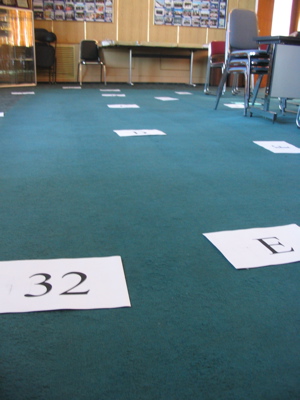
With this makeshift airport, ten MIAT pilots practiced something that they have done thousands of times for real. But today, they did it all in English for the first time ever.
Many of these guys speak a few words of English, but not really. If they are going to keep their jobs, they must learn how to communicate with air traffic control in English. Until today, some of them had never attended a single English class.
We started with the basics. Alpha. Bravo. Charlie. Fly heading three-six-zero. Turn right, heading zero-niner-zero.
Then we practiced with all the phraseology used at the beginning of any flight: Radio check, request startup, request taxi.
We talked about departure information:
“Wind two-seven-zero at one-six meters per second. Sky clear. Temperature minus two-zero, dew point minus two-five, Q-N-H one-zero-one-three. Runway in use, three-two.”
And after we understood all of this, we put it into practice on our little mockup of the Ulaanbaatar airport.
I tried to do the layout correctly, but I’ve never flown at the UB airport and I did not have an airport diagram. I did a very bad job with it, so the burly Mongolian pilots got out of their chairs and took matters into their own hands.
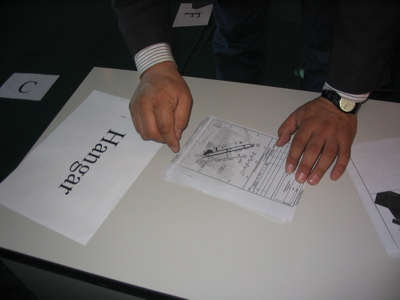
“Taxiway foxtrot, ene uu?
“Ah, bishay! Foxtrot ter bainaa!”
“Oh, za. Bravo baiga uu?
“Bravo baiga.”
“Oh, za!”
“En Runway gochen xoer. En aravan tauv.”
“Za. Zoov zoov!”
The airport was ready.
I appointed the most accomplished English speaker to be the pilot of MIAT’s Antonov 26, Mongolian Airlines Flight 130. My assistant, a former Dutch Air Force test pilot, played the part of an inbound Air China 737. I was the tower control, stationed atop a pile of stackable chairs with the airport complex spread out below.
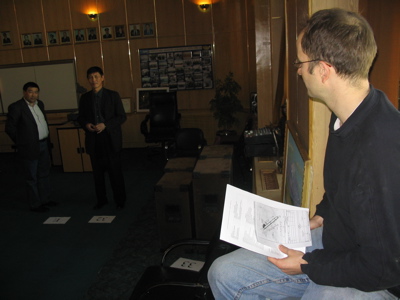
Over the next five minutes, I cleared Air China to land and taxied Mongolian 130 from the terminal to Runway 32 for departure. Once Air China exited the runway, I cleared Mongolian 130 for departure. And it was all in English.
The pilots applauded quietly as their colleague trotted down the runway on his way to Irkutsk, Russia.
See the tall and slender man in the picture above? That’s Arvinbuyan. He’s the chief pilot for the Airbus pilot group. He joined the Antonov class for 10 minutes, which was long enough for him to taxi the Airbus for departure on 3-2, ahead of the Antonov. I hoped that Arvinbuyan’s soft spoken confidence with English would inspire and encourage the Antonov pilots.
We ran the evolution again with a different Mongolian pilot. I made it more complicated and the pilot wracked his brain to repeat all the clearances in English. He did it, mostly.
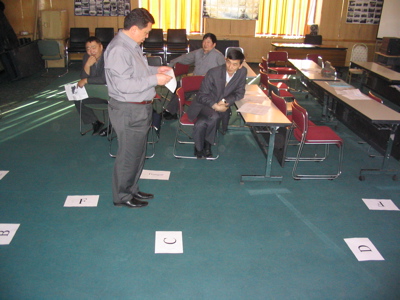
Then I pointed to one of the shier, older guys. “Za,” I said, “Ta Mongolian nick-zuun-gotch. Tiim ay?” “You will be Mongolian one-hundred-thirty, okay?” He pointed to himself incredulously as his eyes got big with disbelief. He shook his head furiously and started speaking in Mongolian.
“He is navigator,” explained one of the pilots. “He does not want.”
“Chaaden,” I said. “Chaaden!” “You are able!”
He shook his head some more and took a few steps backwards. I climbed down from the tower, put my left arm around his shoulders and dragged him back to the airport. I appointed one of the pilots to be his assistant.
With cues whispered from the assistant, this middle aged Mongolian navigator with his big belly and undersized sport coat had the beginnings of a conversation in English.
As I cleared him to “line up and wait” (that’s “position and hold” for you US pilots), I was sorry that such a fun exercise was almost over. Then I got creative.
He told me that he was ready for departure, expecting that I would clear him for departure on Runway 3-2. Instead, I said, “Departure not approved. Taxi to Runway 1-5 via Runway 3-2 and Taxiway 1. Hold short of 1-5.”
He didn’t miss a beat. He repeated the clearance perfectly with no help and lumbered down the runway according to the clearance. I cleared him to depart and there was more applause.
The guy was beaming. “That is first English class! That is first English class!”
I adjourned class 20 minutes early, since I knew it would be impossible to end on any higher note.
 Valentine’s Day
  What $35 Will Get You
  Luang Prabang