Mongol Hillne Hichel
by Rachel
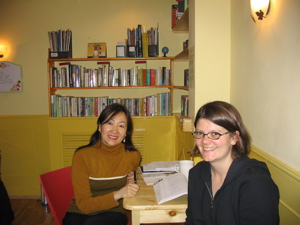
I have been slogging on through Mongolian. In an effort to actually accomplish something I started studying five days per week. I meet my teacher, Sovda, at the Stupa Café. It is a very calm and pleasant restaurant and hangout place next to a Buddhist center. I usually drink a cup of peppermint tea while Sovda and I talk and work through the lessons in the book.
Mongolian has eight cases, which I might be better at if I remembered anything from those years of Latin. I have learned five cases so far: nominative, genitive, dative, accusative, and commitative. Each one comes complete with pronouns, frequently used verbs and terrible spelling rules. There are exceptions to every rule, mostly based on the Ancient Mongolian Script.
Mongolian is an agglutinative language, so sounds get stuck onto the end of nouns. By the end it is impossible for my untrained ears to know what is what. For example, if you wanted to ask “Have you seen my book?” the word book gets “aig” for specifying a particular thing and ”aa” for my, so nom (book) becomes nomaigaa. Or in “I talked to my mother,” eej (mother) gets “tay” for with and “ay” for my, so the result is eejtayay. It takes me awhile to decode words like this in the midst of a sentence. The neat part, though, is that you can say a lot with a few words. Where are you going? “Gerluugee yavn.” I will go to my house.
It is also hard for me to simply say some of the sounds. There are four different vowel sounds on the “o” to “u” spectrum. There is also the kh sound, which sometimes can be more like a k, and sometimes more like an h, but at other times is like a growl in the top of your throat. Then there are more fussy things, like the ‘l” sound. English l’s are made with your tongue at the top of your mouth, behind your front teeth. In Mongolian you move your tongue to one side of your mouth instead.
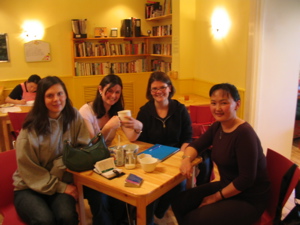
On Thursdays I don’t meet Sovda. Instead I go to a conversation group with Dogoo Bagsh (Teacher Dogoo) instead. A rotating cast of ex-pats comes to talk in Mongolian. Here I am with Dogoo Bagsh and Reta and Lauren, two Fulbright scholars. They both speak very good Mongolian, and I struggle to keep up. Reta also has a duck piñata that we will someday get to destroy.
All in all it is good, and I am making some progress. I still can rarely say what I want to be able to say, but I hope that day is getting closer. I was a little depressed when I realized that it has been almost 11 months since we started our first Mongolian lessons. In fact, come President’s Day, this whole thing will have been in the works for a year.
 Spring Evening
  A Good Deal