Tsaagan Sar
By Charlie
Thank God for Scotch Whiskey.
The usual drink of the Mongolian New Year is vodka, but Mongolians seem to appreciate a fine Scotch. This fact made my first Tsaagan Sar pleasant, if not somewhat inebriated.
Tsaagan Sar means White Month. It is the lunar new year celebration. You’ve heard about the Chinese New Year. This is the Mongolian equivalent. It is a family holiday. We don’t have anything like it in American culture. Thanksgiving might be the closest analog.
I will not attempt to explain Tsaagan Sar because I do not understand it. I don’t even know the official days on which the holiday is celebrated. Calendars show public holidays on January 30, 31 and February 1, but the celebrations apparently extend well beyond that period. Like most of Mongolian life, Tsaagan Sar is not meant to be understood by visitors.
Because it is a family holiday, it is a great honor when someone invites you to celebrate Tsaagan Sar with their family. Rachel and I received one such invitation from The Great Moogii, my former colleague at the newspaper. We have some vague invitations to celebrate with a few Mongolian families, but Moogii’s invitation was special because it was an invitation for the First Day of Tsaagan Sar, a day that is usually reserved for family.
Rachel felt under the weather this morning, so I went alone. I told the taxi driver to take me to the gal terrikhiin buudaal, the train station. I called Moogii en route and she gave more precise instructions to the taxi driver.
The taxi dropped me at a supermarket surrounded by Soviet apartment buildings. I paid the driver 1,000 togrogs (about 80 cents) and hopped out of the cab. I looked around and had no idea what to do next. As I fumbled around for my mobile phone, Moogii’s son appeared to meet me. We entered one of the Soviet buildings and took a little elevator.
I entered the apartment and was quickly escorted to greet Moogii’s father before I could even take off my coat. Batsukh sat at the head of a gigantic table filled to capacity with a Mongolian feast. Somebody stood behind me and helped me thrust my arms forward to greet the seated elder. Moogii’s father picked up a blue prayer cloth and draped it over his arms, which he then used to grasp my extended arms. “Aimaar baina uu!” was the greeting.
We held arms briefly before he let me go. As I straightened up, Moogii’s father started speaking in Mongolian and Moogii translated. “He wants to kiss you,” she said. So I approached and he kissed me on both cheeks.
I took my seat and the drinking began.
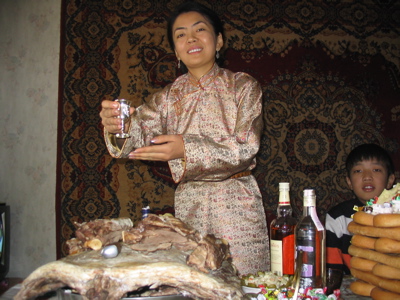
That’s Moogii passing the first of countless shots. This picture is full of symbolism. First, the ever fashionable and western Moogii is dressed in a magnificent Mongolian del. Lots of Mongolians wear dels, but this one is special for Tsaagan Sar. Moogii’s mother made it for her.
Then notice that Moogii is handing me the shot with her right hand. Of course it is common throughout the world for important things to be passed with the right hand. But here in Mongolia, special reverence is paid when the left hand supports the right hand. You can see Moogii’s left hand positioned under her right forearm. Very important!
You can see a pile of pastries to the right, a pile of mutton to the left and Moogii’s son, Tsomo. Also note that the bottle of Scotch is nearly full.
Moogii’s father, Batsukh, lead the drinking. He raised his glass and I followed. “Sain baina,” he said, and we drank.
“Sain baina,” he said again, and we drank again. And again. And again.
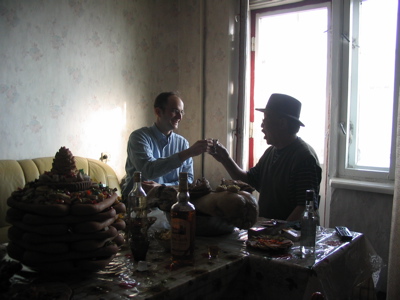
Then we ate. Batsukh took a knife and trimmed some mutton from the huge sheep’s rump on the table. The meat was cooked, but cold. Batsukh explained that he had cooked the meat in a ger that was located someplace close to the apartment. It’s a good thing that there was a ger nearby, since the apartment had no oven.
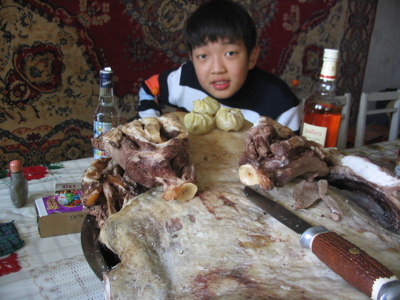
About halfway through the festivities, Batsukh rotated the pile of mutton to give me a direct shot of the sheep’s rump. And here it is, in all of it’s fatty wonder.
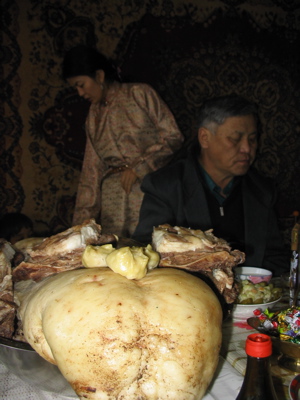
Mongolians absolutely love to eat animal fat in any form, but Batsukh made a point of trimming my mutton so that I ate pure meat with no fat at all.
After a couple of hours, other members of the family arrived, starting with Batsukh’s younger brother.
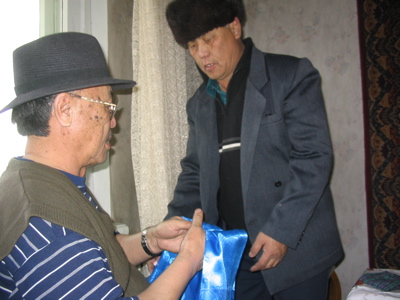
“He is 50 and not married,” explained Moogii in English.
“He is a train engineer,” explained Batsukh in Mongolian.
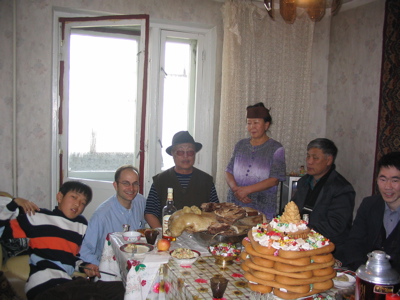
Then other relatives arrived: Batsuk’s younger sister, her son, daughter, grandchildren and in-laws. Each and every one of the new arrivals greeted Batsukh, the elder, in the same way that I had been coached to greet him.
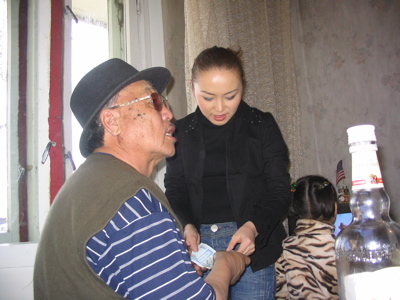
That woman is Batsukh’s daughter in-law. She is apparently also the daughter of Mongolia’s recently deposed prime minister. UB is a small town.
Most of the visitors gave Batsukh some money as a sign of respect.
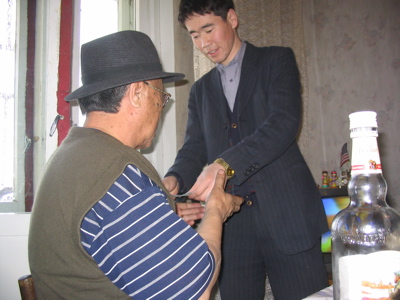
Moogii poured the Scotch – again and again and again.
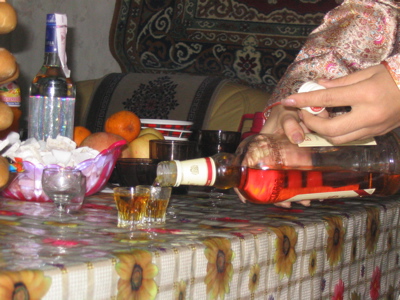
Even before the other family members arrived, Batsukh and I had polished off about half a liter of Scotch. Six months ago, that may well have killed me. These days, it’s no big deal.
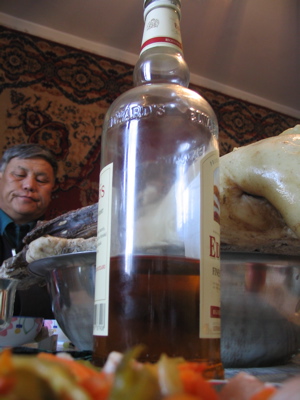
Recall that the bottle was full when this blog entry began. As you can see, it is more than half finished in this picture.
Keeping pace with the drinking were the Mongolian dumplings, or buutz. These are a lot like the steamed dumplings that you get in any Chinese restaurant, except that they are filled with chopped mutton!
“Ta xidden buutz xiisen vay?” I asked Moogii’s mother. “How many buutz did you make?”
“Myankh,” she said. “1,000.”
Moogii then explained that there is one special buutz that was made with a “nipple.” “What?” I said. “You know,” she said, “a nickel, a coin.”
Right. The person who eats the buutz with a coin has good luck for the year ahead. I ate a lot of buutz, but I failed to ingest the coin.
Of course there was also smoking.
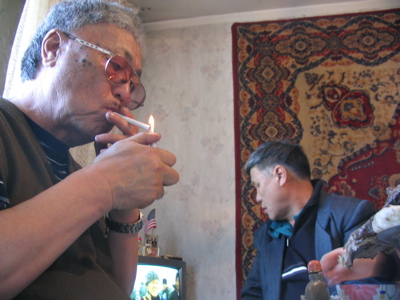
And the TV was on the entire time, which was actually very nice. Mongolian State Television does it’s own version of the Yule Log by broadcasting sounds and images appropriate for Tsaagan Sar. There was lots of Mongolian music set to images of the Mongolian countryside in winter.
You know how American networks celebrate the season with little sprigs of holy or an American flag in the corner of the screen? Mongolian State Television celebrates Tsaagan Sar with a tiny blue Buddhist prayer scarf draped over the State TV logo in the upper right hand corner of the screen.
After about two hours, Moogii said, “When my mother gives you a present, that means it is okay for you to go – or stay.” Sometime after that, Moogii’s mother delivered the presents. Rachel got some massage cream that is “special for women” and a shirt. I got some nice things made out of felt and four knuckle bones – one each from a camel, a goat, a sheep and a horse.
These knuckle bones are used like dice in an ancient Mongolian game. You throw the knuckles and read your fortune. The first time I threw the knuckles, I scored a perfect four. According to the guide, my fortune is thus:
“The best portent appears.
Everything will be successful.
Everlasting luck.
It will be kept for long time.”
How you like them apples?
 Finally!
  Miscellany
  Finally, An Assistant